
Despite the Grip’s smaller size, JBL pegs battery life on both speakers at the same 14-hour maximum. On the Grip at least, that might be overpromising. When I ran the speaker at 50% volume continuously, I only got about 10.5 hours. Using JBL’s PlayTime Boost mode could help if you really need to eke out a few more songs.
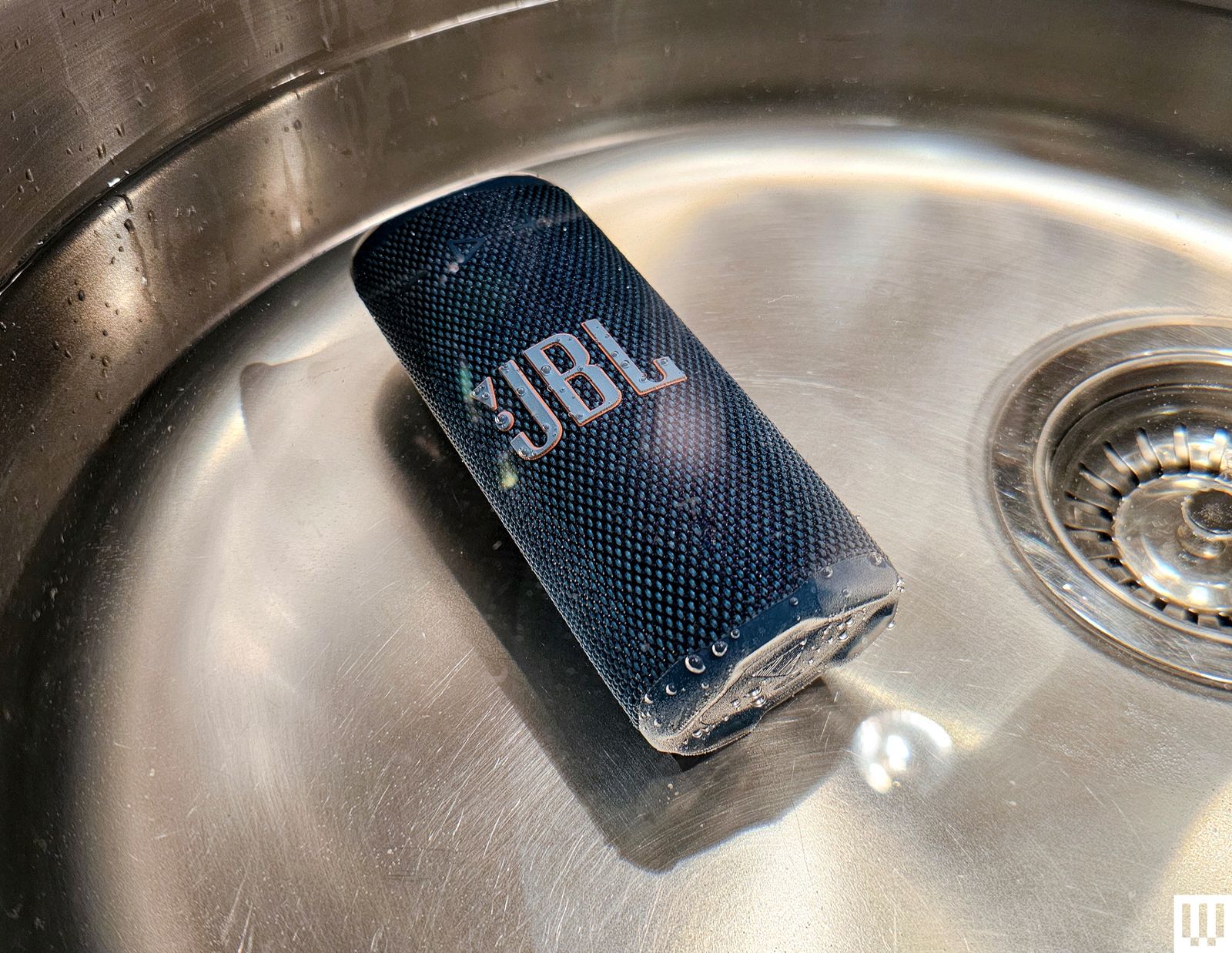
The familial similarities continue with the Grip’s ability to withstand the elements. Like the Flip 7, it’s rated IP68, making it effectively dust and waterproof. They’re both shockproof, and yet the Grip is arguably more durable since both ends are solid silicone rubber. The Flip’s ends are passive radiators, which could be permanently damaged by a sharp object. Just keep in mind that while the Grip won’t be bothered by immersion in water, it doesn’t float. So if you toss it in the pool, someone will be diving in to retrieve it.
The one difference between these siblings (other than size, power, and the Grip’s built-in light show) is orientation. While the Flip 7 can be used vertically or horizontally, the Grip is designed for vertical use only. Not that there’s anything stopping you from laying it down — the built-in loop will keep it from rolling too far. But the controls are positioned for easier access when standing up, and the rear LED panel will end up partially obscured if the speaker is sideways.

Photograph: Simon Cohen
Lava Lamp
Speaking of that LED panel, it’s a fun add-on, but don’t expect it to light up your get-together. There are four colors to choose from (purple, red, an icy-blue, and a vibrant blue) controlled by the JBL Portables app, and five display modes: four that animate and one that’s static. At full brightness, it can’t compete with a well-lit room, and outdoors, you’ll definitely have to keep your expectations in check. Still, in a darkened room, with the Grip near a corner or wall, it can create a subtle mood. Unfortunately, the four animated modes (Bounce, Trim, Switch, and Neon) don’t sync to your music, so the effect is more lava lamp than disco light. If you want a beat-coordinated light show, consider the excellent Tribit StormBox Mini+ ($40), which has a top-mounted LED ring with this feature.
The one thing about the LED panel that perplexes me is its placement: it’s on the “rear” of the speaker. If you can see the light show, it means the Grip’s single racetrack driver is facing away from you. It’s not a massive difference in sound quality, but it’s noticeable, especially in the upper midranges and highs, which lose some of their clarity.
Services Marketplace – Listings, Bookings & Reviews