
Is it possible to have too much of a good thing? The Kia EV9 was one of the first EVs from an established automaker truly designed for American tastes. It’s a big, boxy SUV that gives drivers a commanding view of the road, while three rows of seats and quick charging make it perfect for family road trips. But it was destined to become a victim of sibling rivalry.
A big part of what makes the EV9 great is its E-GMP architecture, which is shared with other Hyundai Motor Group brands. So it was only a matter of time before parent brand Hyundai decided to cash in on this potentially profitable niche with its own three-row electric SUV. That vehicle went on sale earlier this year as the Ioniq 9. And it’s giving the EV9 a run for its money.
Differing designs, similar dimensions

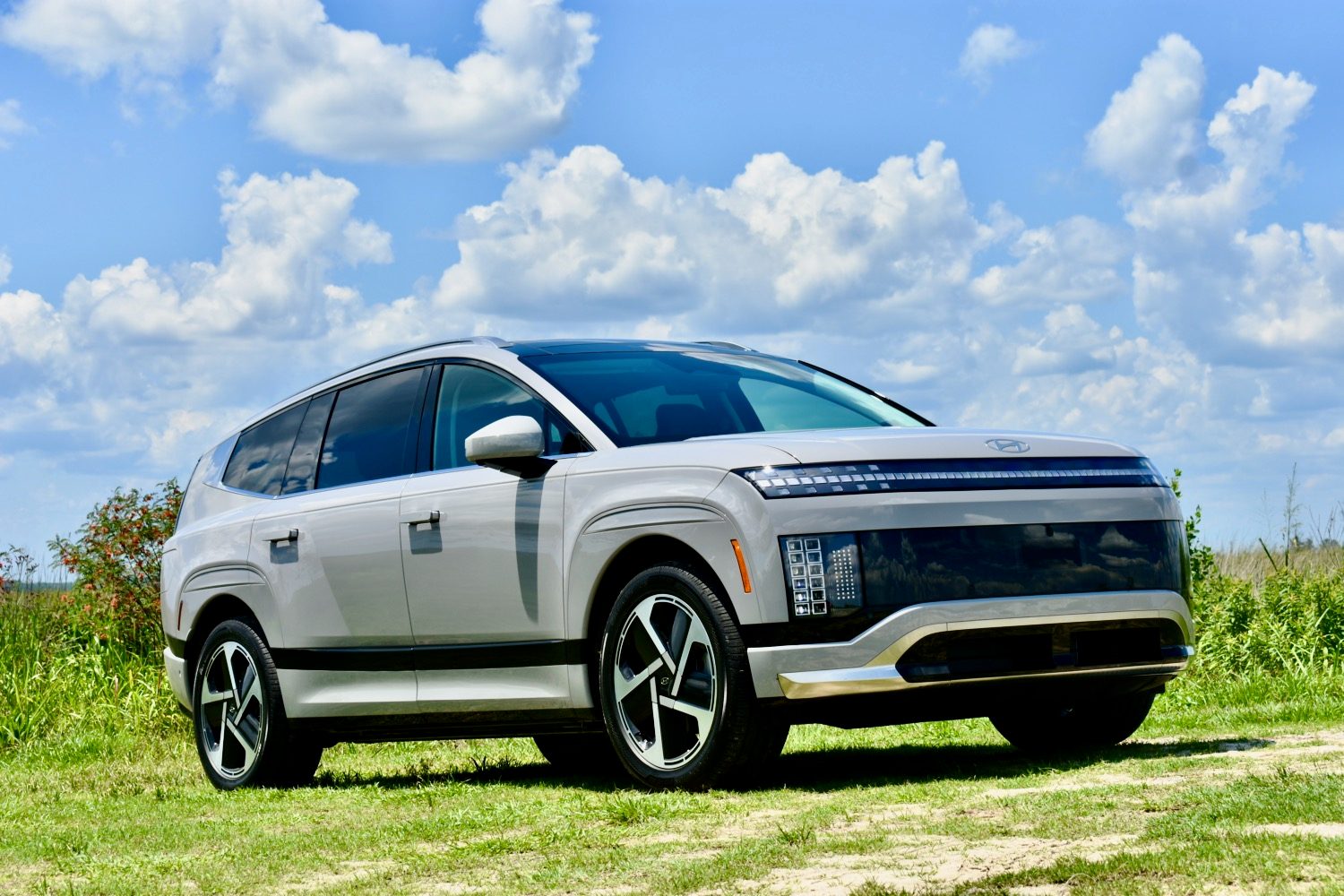
Despite sharing platforms, Kia and Hyundai have crafted different EV aesthetics. The Kia EV6 is sleek and of-the-moment, while the Hyundai Ioniq 5 is a retro homage. That’s also the case with these bigger SUVs. The EV9 is almost entirely comprised of sharp angles, translating the traditional Etch A Sketch SUV profile into Kia’s EV design language. The Ioniq 9’s designers took an angle grinder to those corners, giving Hyundai’s electric SUV rounded edges accentuated by the pixel-like lighting that is a signature feature of the Ioniq EVs.
The EV9 and Ioniq 9 are pretty much the same size, though. The Hyundai is 2.0 inches longer, 1.6 inches taller, and just 0.1 inch wider — not very noticeable on vehicles this big. No matter which of the three rows you sit in, headroom and legroom are also too close to make a difference. The Hyundai’s 21.9 cubic feet of cargo space behind its third row, 46.7 cubic feet behind its second row, and 86.9 cubic feet behind its first row beats the Kia by 1.7 cubic feet, 3.2 cubic feet, and 5.2 cubic feet, respectively. Neither SUV has a true frunk.
Pricing crosses over at the top of each lineup, but where the top Kia EV9 GT-Line goes for a sporty aesthetic with red ambient lighting and interior materials that look sourced from a sci-fi show’s costume department, the Hyundai Ioniq 9 Calligraphy Design leans more toward traditional luxury. Both feature dual 12.3-inch screens and standard wireless Apple CarPlay and Android Auto, but the Hyundai also has a clever sliding center console.
Specs don’t tell the whole story


Both brands offer single-motor rear-wheel drive and dual-motor all-wheel drive models, but Hyundai also gives top-trim all-wheel drive models more power. Kia has said it will add a more powerful EV9 GT to the lineup, but in the meantime it just locks maximum torque for all-wheel drive EV9 models behind a paywall. And while the EV9 is available with 76.1-kilowatt-hour and 99.8-kWh battery packs, all Ioniq 9 models use the same 110.3-kWh pack.
Rear-wheel drive models have identical outputs, and the most powerful versions are both capped at 516 pound-feet of torque. The Ioniq 9 also makes up to 422 horsepower, compared to 379 hp for the EV9, getting it from zero to 60 mph 0.1 second quicker, at 4.9 seconds.
The real difference, though, is in handling. The Hyundai has a more relaxed feel than the Kia, which always seems to be fighting against its own considerable weight in an attempt to feel sporty. Its low-effort steering is also a nice change of pace from the Kia’s leaden helm. Ride quality in both vehicles is fairly good, but where the Kia feels like a truck, the Hyundai feels like a luxury sedan that just happens to have a taller ride height.
Same impressive charging hardware


The Ioniq 9’s bigger battery pack gives it a range advantage. All versions of the Hyundai top 300 miles, from 311 miles for the Limited, Calligraphy, and Calligraphy Design models to 335 miles for the rear-wheel drive S base model. The only version of the EV9 that surpasses 300 miles is the rear-wheel drive Light Long Range, which is rated at 305 miles.
For the 2026 model year, both SUVs switch to North American Charging Standard (NACS) ports in order to gain access to Tesla Supercharger stations. However, you’ll want to use a Combined Charging Standard (CCS) adapter to get the quickest DC fast-charging times. Both Hyundai and Kia say a 10%-80% charge should take less than 30 minutes, with slightly longer charging times for the Hyundai owing to its larger battery pack.
The E-GMP architecture also incorporates vehicle-to-load (V2L) capability, allowing EVs to discharge power through built-in outlets to run tools and electronics or, with the right hardware, serve as emergency backup home power. That functionality is enabled on both the EV9 and Ioniq 9.
Lower price doesn’t mean better value


The EV9 and Ioniq 9 are two very similar SUVs, but pricing differences widen the gap between them. The Kia’s $56,495 base price is about $4,000 less than that of the Hyundai, but that’s for a model with only 230 miles of range. The Ioniq 9 lineup is also more heavily weighted toward high-end trim levels, but at roughly $75,000 with options, a loaded EV9 GT-Line still costs about the same as the penultimate Ioniq 9 Calligraphy trim level. For that price, the Hyundai’s extra range and more pleasant driving experience give you more for your money.
Neither Korean SUV really makes sense at more than $70,000 though, not when you can get a base Lucid Gravity or Rivian R1S for similar money. Kia and Hyundai was mainstream brands, after all. Their electric SUVs make more sense at the lower price points Lucid and Rivian can’t match. But a 335-mile base model once again hands the advantage to Hyundai. It’s an unfortunate situation for Kia, but it shows how quickly the EV market is evolving.
Services Marketplace – Listings, Bookings & Reviews