
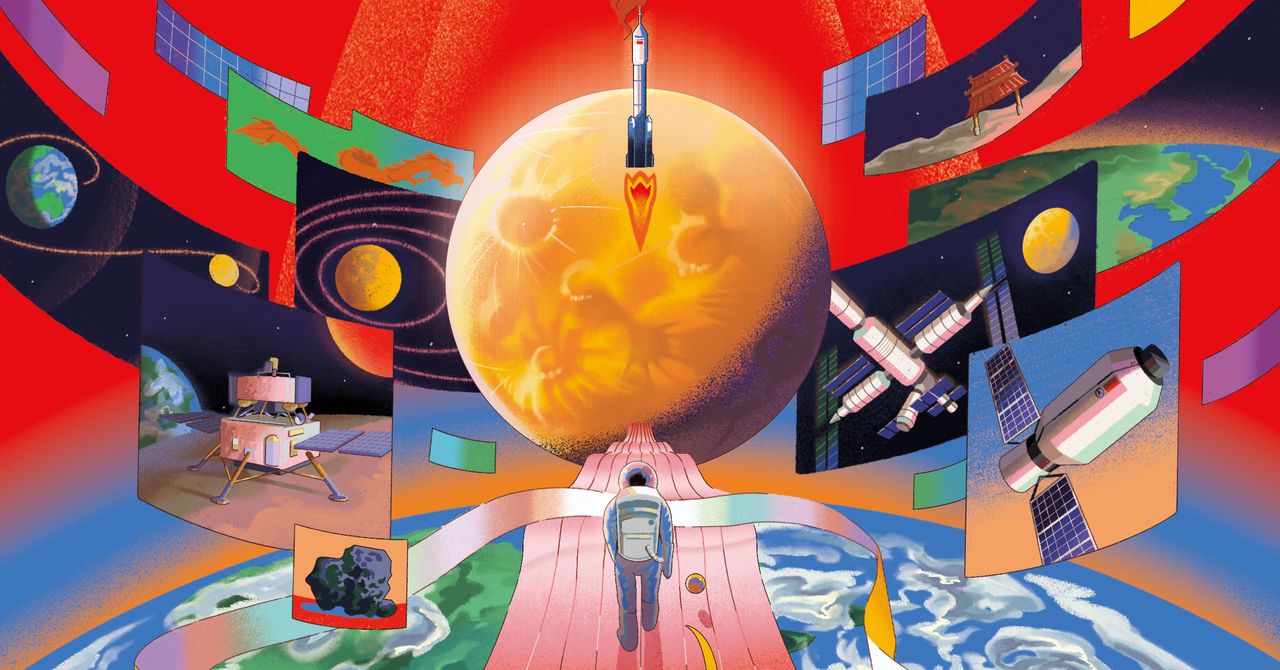

The senator wanted a promise. A solemn vow. For the last six years—or maybe the last decade or quarter century, depending on how you count it—the United States and China had been locked in a space race, a contest to see which nation could put its people on the moon. Senator Ted Cruz wanted President Donald Trump’s nominee to run NASA, Jared Isaacman, to pledge that the US would not lose.
Cruz brought a little surprise to Isaacman’s confirmation hearing last April. It was a poster of the moon. On one side stood three astronauts and a giant Chinese flag. On the other were two more figures in space suits, with the tiniest Stars and Stripes planted in the lunar soil. Cruz apologized for the imbalance. “My team used ChatGPT,” explained the senator, who chairs the committee that oversees NASA.
Then Cruz, with a bit more seriousness, asked Isaacman, “Do we have your commitment that you will not allow the scenario on the right of this poster to happen? That China will not beat us to the moon?”
Isaacman, a billionaire entrepreneur who had paid for his own missions to space, replied, “Senator, I only see the left-hand portion of that poster.”
It was a red-meat, fuck-yeah, pitch-perfect response. And Isaacman may have meant it. But by the time of his testimony, the Trump administration had started a process that would lay waste to NASA, pushing nearly 4,000 agency employees to quit. Then the White House proposed a massive, 24 percent cut to NASA’s budget. Then Trump yanked Isaacman’s nomination and named a new part-time acting chief, a fellow who boasted in his official NASA biography that he is one-half of “America’s first and longest-married reality TV couple.” Then that guy picked a fight with Elon Musk, who’s building NASA’s moon lander. And Isaacman was back in the running. In December, Trump capped off the year with an executive order pushing Americans to get back to the moon by 2028.
If all of this sounds suboptimal to you, welcome to the club, space ranger. That dysfunction is one of many reasons why the vast majority of the two dozen sources I interviewed for this story believe that China will put people on the moon first. I spoke with nine former NASA officials who served at the highest rungs of the space agency under presidents Trump and Biden; none of them were optimistic about America’s chances. “We did the worst of all worlds,” one of the nine tells me. “We positioned it as a race without planning to win.”
The original space program was the ultimate symbol of America at its screaming-eagle apex. Rocket scientist was shorthand for brilliant, and many of them were working in Huntsville, Alabama, aka Rocket City. The word astronaut was synonymous with grit, and you could find the gutsiest of them in Houston. Moonshot was (and is) code for something borderline impossible. Space races have helped spur the development of everything from the integrated circuit to the solar panel to 5G. But that was before America decided to stab itself in the brain.
Today, much of the world drives Chinese electric cars, powers their homes with Chinese solar panels, and stays in touch with made-in-China phones. Chinese scientists have eclipsed their American counterparts in the production of high-quality research, and the White House has responded by gutting American science funding and charging $100,000 to let in highly skilled immigrants. So if Chinese astronauts step down from their lander and livestream the results in 4K—and to be clear, it’s still an “if” at this point—it’ll be more than a point of national pride for Beijing. It’ll be a declaration that the American Century is officially over.
Services Marketplace – Listings, Bookings & Reviews